Lighting Concept

01
What is light?

a) Light

Light (from the Latin lux, lucis) is the part of electromagnetic radiation that can be perceived by the human eye.
‍
In physics, the term light is considered to be part of the field of radiation known as the electromagnetic spectrum, while visible light expression specifically designates radiation in the visible spectrum.
Light, like all electromagnetic radiation, is made up of elementary particles devoid of mass called photons, whose properties according to the wave-particle duality explain the characteristics of their physical behavior.
‍
Light is that part of the electromagnetic spectrum that is perceived by our eyes.
‍
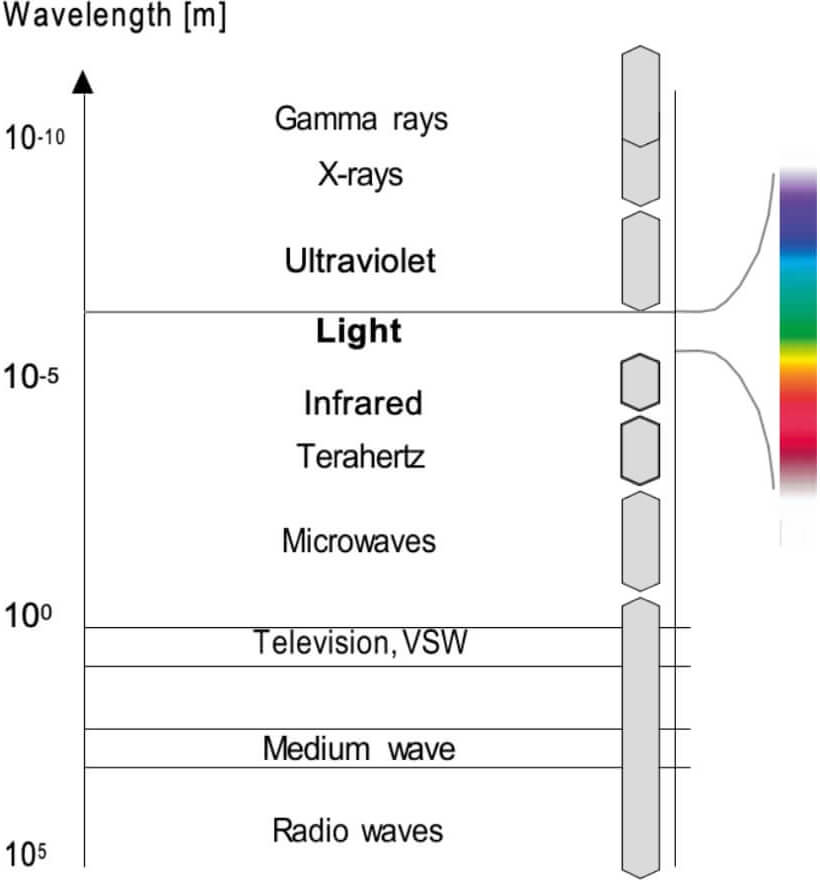
Of the entire spectrum, the portion that humans can see is very small compared to the other spectral regions. This region, called the visible spectrum, comprises wavelengths from 380 nm to 780 nm. The human eye perceives the light of each of these wavelengths as a different color, therefore, in the decomposition of white light in all its wavelengths, by prisms or by the rain in the rainbow, the eye sees all colors.
In the back of the eye there are millions of cells specialized in detecting the wavelengths coming from our environment. These cells, mainly rods and cones, collect the different elements of the spectrum of sunlight and transform them into electrical impulses, which are then sent to the brain through the optic nerves. The brain (specifically the visual cortex, which is found in the occipital lobe) is responsible for making color perception conscious.
‍
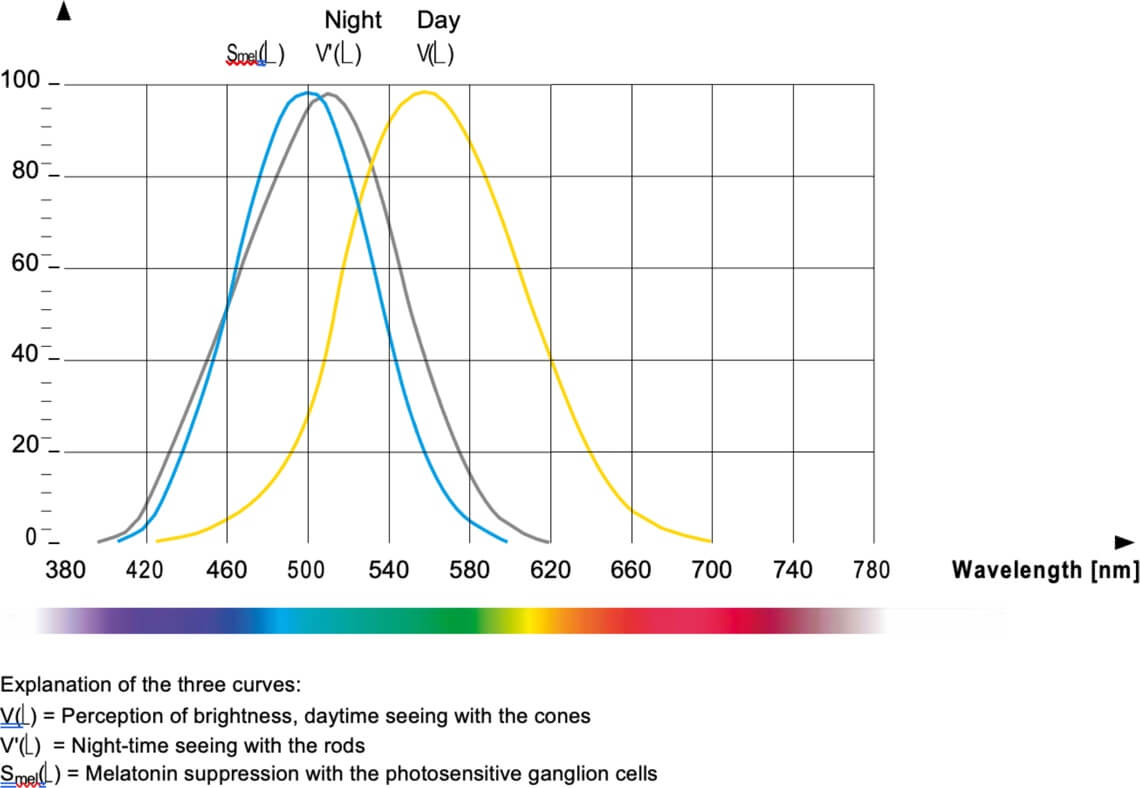
Cones are responsible for color vision. There are three types of cones, sensitive to the colors red, green, and blue, respectively. Given their way of connection to the nerve endings that go to the brain, they are responsible for spatial definition. They are also not very sensitive to light intensity and provide photopic vision (vision at high levels).
‍
The rods are responsible for scotopic vision (vision at low levels). Rods are much more sensitive than cones to light intensity, so they contribute aspects such as brightness and tone to color vision and are responsible for night vision.
‍
The retina also contains photosensitive ganglion cells. These cells are sensitive to blue light and suppress the sleep hormone melatonin.  Melatonin is responsible for a good sleep at night. Suppressing melatonin in the morning by the blue light helps to keep you awake during the day.
‍
This means that the right light can control the circadian rhythms and thus a healthy waking and sleeping behavior.

b) Human Eye Perception

(1) Relative spectral perception of brightness and melanopic effectEffect as a percentage
02
How does lighting affect our lives?

a) Light

Light (from the Latin lux, lucis) is the part of electromagnetic radiation that can be perceived by the human eye.
‍
In physics, the term light is considered to be part of the field of radiation known as the electromagnetic spectrum, while visible light expression specifically designates radiation in the visible spectrum.
Light, like all electromagnetic radiation, is made up of elementary particles devoid of mass called photons, whose properties according to the wave-particle duality explain the characteristics of their physical behavior.
‍
Light is that part of the electromagnetic spectrum that is perceived by our eyes.
‍
Of the entire spectrum, the portion that humans can see is very small compared to the other spectral regions. This region, called the visible spectrum, comprises wavelengths from 380 nm to 780 nm. The human eye perceives the light of each of these wavelengths as a different color, therefore, in the decomposition of white light in all its wavelengths, by prisms or by the rain in the rainbow, the eye sees all colors.

In the back of the eye there are millions of cells specialized in detecting the wavelengths coming from our environment. These cells, mainly rods and cones, collect the different elements of the spectrum of sunlight and transform them into electrical impulses, which are then sent to the brain through the optic nerves. The brain (specifically the visual cortex, which is found in the occipital lobe) is responsible for making color perception conscious.
‍
Cones are responsible for color vision. There are three types of cones, sensitive to the colors red, green, and blue, respectively. Given their way of connection to the nerve endings that go to the brain, they are responsible for spatial definition. They are also not very sensitive to light intensity and provide photopic vision (vision at high levels).
‍
The rods are responsible for scotopic vision (vision at low levels). Rods are much more sensitive than cones to light intensity, so they contribute aspects such as brightness and tone to color vision and are responsible for night vision.
‍
The retina also contains photosensitive ganglion cells. These cells are sensitive to blue light and suppress the sleep hormone melatonin.  Melatonin is responsible for a good sleep at night. Suppressing melatonin in the morning by the blue light helps to keep you awake during the day.
‍
This means that the right light can control the circadian rhythms and thus a healthy waking and sleeping behavior.

b) Human Eye Perception

(1) Relative spectral perception of brightness and melanopic effectEffect as a percentage
03
What are the basic parameters used in lighting?

a) Light

Light (from the Latin lux, lucis) is the part of electromagnetic radiation that can be perceived by the human eye.
‍
In physics, the term light is considered to be part of the field of radiation known as the electromagnetic spectrum, while visible light expression specifically designates radiation in the visible spectrum.
Light, like all electromagnetic radiation, is made up of elementary particles devoid of mass called photons, whose properties according to the wave-particle duality explain the characteristics of their physical behavior.
‍
Light is that part of the electromagnetic spectrum that is perceived by our eyes.
‍
Of the entire spectrum, the portion that humans can see is very small compared to the other spectral regions. This region, called the visible spectrum, comprises wavelengths from 380 nm to 780 nm. The human eye perceives the light of each of these wavelengths as a different color, therefore, in the decomposition of white light in all its wavelengths, by prisms or by the rain in the rainbow, the eye sees all colors.
In the back of the eye there are millions of cells specialized in detecting the wavelengths coming from our environment. These cells, mainly rods and cones, collect the different elements of the spectrum of sunlight and transform them into electrical impulses, which are then sent to the brain through the optic nerves. The brain (specifically the visual cortex, which is found in the occipital lobe) is responsible for making color perception conscious.
‍
Cones are responsible for color vision. There are three types of cones, sensitive to the colors red, green, and blue, respectively. Given their way of connection to the nerve endings that go to the brain, they are responsible for spatial definition. They are also not very sensitive to light intensity and provide photopic vision (vision at high levels).
‍
The rods are responsible for scotopic vision (vision at low levels). Rods are much more sensitive than cones to light intensity, so they contribute aspects such as brightness and tone to color vision and are responsible for night vision.
‍
The retina also contains photosensitive ganglion cells. These cells are sensitive to blue light and suppress the sleep hormone melatonin.  Melatonin is responsible for a good sleep at night. Suppressing melatonin in the morning by the blue light helps to keep you awake during the day.
‍
This means that the right light can control the circadian rhythms and thus a healthy waking and sleeping behavior.

b) Human Eye Perception

(1) Relative spectral perception of brightness and melanopic effectEffect as a percentage
04
How to specify the illuminance level?

a) Light

Light (from the Latin lux, lucis) is the part of electromagnetic radiation that can be perceived by the human eye.
‍
In physics, the term light is considered to be part of the field of radiation known as the electromagnetic spectrum, while visible light expression specifically designates radiation in the visible spectrum.
Light, like all electromagnetic radiation, is made up of elementary particles devoid of mass called photons, whose properties according to the wave-particle duality explain the characteristics of their physical behavior.
‍
Light is that part of the electromagnetic spectrum that is perceived by our eyes.
‍
Of the entire spectrum, the portion that humans can see is very small compared to the other spectral regions. This region, called the visible spectrum, comprises wavelengths from 380 nm to 780 nm. The human eye perceives the light of each of these wavelengths as a different color, therefore, in the decomposition of white light in all its wavelengths, by prisms or by the rain in the rainbow, the eye sees all colors.
In the back of the eye there are millions of cells specialized in detecting the wavelengths coming from our environment. These cells, mainly rods and cones, collect the different elements of the spectrum of sunlight and transform them into electrical impulses, which are then sent to the brain through the optic nerves. The brain (specifically the visual cortex, which is found in the occipital lobe) is responsible for making color perception conscious.
‍
Cones are responsible for color vision. There are three types of cones, sensitive to the colors red, green, and blue, respectively. Given their way of connection to the nerve endings that go to the brain, they are responsible for spatial definition. They are also not very sensitive to light intensity and provide photopic vision (vision at high levels).
‍
The rods are responsible for scotopic vision (vision at low levels). Rods are much more sensitive than cones to light intensity, so they contribute aspects such as brightness and tone to color vision and are responsible for night vision.
‍
The retina also contains photosensitive ganglion cells. These cells are sensitive to blue light and suppress the sleep hormone melatonin.  Melatonin is responsible for a good sleep at night. Suppressing melatonin in the morning by the blue light helps to keep you awake during the day.
‍
This means that the right light can control the circadian rhythms and thus a healthy waking and sleeping behavior.

b) Human Eye Perception

(1) Relative spectral perception of brightness and melanopic effectEffect as a percentage
05
What are the factors for choosing light color?

a) Light

Light (from the Latin lux, lucis) is the part of electromagnetic radiation that can be perceived by the human eye.
‍
In physics, the term light is considered to be part of the field of radiation known as the electromagnetic spectrum, while visible light expression specifically designates radiation in the visible spectrum.
Light, like all electromagnetic radiation, is made up of elementary particles devoid of mass called photons, whose properties according to the wave-particle duality explain the characteristics of their physical behavior.
‍
Light is that part of the electromagnetic spectrum that is perceived by our eyes.
‍
Of the entire spectrum, the portion that humans can see is very small compared to the other spectral regions. This region, called the visible spectrum, comprises wavelengths from 380 nm to 780 nm. The human eye perceives the light of each of these wavelengths as a different color, therefore, in the decomposition of white light in all its wavelengths, by prisms or by the rain in the rainbow, the eye sees all colors.
In the back of the eye there are millions of cells specialized in detecting the wavelengths coming from our environment. These cells, mainly rods and cones, collect the different elements of the spectrum of sunlight and transform them into electrical impulses, which are then sent to the brain through the optic nerves. The brain (specifically the visual cortex, which is found in the occipital lobe) is responsible for making color perception conscious.
‍
Cones are responsible for color vision. There are three types of cones, sensitive to the colors red, green, and blue, respectively. Given their way of connection to the nerve endings that go to the brain, they are responsible for spatial definition. They are also not very sensitive to light intensity and provide photopic vision (vision at high levels).
‍
The rods are responsible for scotopic vision (vision at low levels). Rods are much more sensitive than cones to light intensity, so they contribute aspects such as brightness and tone to color vision and are responsible for night vision.
‍
The retina also contains photosensitive ganglion cells. These cells are sensitive to blue light and suppress the sleep hormone melatonin.  Melatonin is responsible for a good sleep at night. Suppressing melatonin in the morning by the blue light helps to keep you awake during the day.
‍
This means that the right light can control the circadian rhythms and thus a healthy waking and sleeping behavior.

b) Human Eye Perception

(1) Relative spectral perception of brightness and melanopic effectEffect as a percentage
06
What are the differences between normal LED and LAVOV’s LED?

a) Light

Light (from the Latin lux, lucis) is the part of electromagnetic radiation that can be perceived by the human eye.
‍
In physics, the term light is considered to be part of the field of radiation known as the electromagnetic spectrum, while visible light expression specifically designates radiation in the visible spectrum.
Light, like all electromagnetic radiation, is made up of elementary particles devoid of mass called photons, whose properties according to the wave-particle duality explain the characteristics of their physical behavior.
‍
Light is that part of the electromagnetic spectrum that is perceived by our eyes.
‍
Of the entire spectrum, the portion that humans can see is very small compared to the other spectral regions. This region, called the visible spectrum, comprises wavelengths from 380 nm to 780 nm. The human eye perceives the light of each of these wavelengths as a different color, therefore, in the decomposition of white light in all its wavelengths, by prisms or by the rain in the rainbow, the eye sees all colors.
In the back of the eye there are millions of cells specialized in detecting the wavelengths coming from our environment. These cells, mainly rods and cones, collect the different elements of the spectrum of sunlight and transform them into electrical impulses, which are then sent to the brain through the optic nerves. The brain (specifically the visual cortex, which is found in the occipital lobe) is responsible for making color perception conscious.
‍
Cones are responsible for color vision. There are three types of cones, sensitive to the colors red, green, and blue, respectively. Given their way of connection to the nerve endings that go to the brain, they are responsible for spatial definition. They are also not very sensitive to light intensity and provide photopic vision (vision at high levels).
‍
The rods are responsible for scotopic vision (vision at low levels). Rods are much more sensitive than cones to light intensity, so they contribute aspects such as brightness and tone to color vision and are responsible for night vision.
‍
The retina also contains photosensitive ganglion cells. These cells are sensitive to blue light and suppress the sleep hormone melatonin.  Melatonin is responsible for a good sleep at night. Suppressing melatonin in the morning by the blue light helps to keep you awake during the day.
‍
This means that the right light can control the circadian rhythms and thus a healthy waking and sleeping behavior.

b) Human Eye Perception

(1) Relative spectral perception of brightness and melanopic effectEffect as a percentage
07
Is there any risk in using light? What is the regulation?

a) Light

Light (from the Latin lux, lucis) is the part of electromagnetic radiation that can be perceived by the human eye.
‍
In physics, the term light is considered to be part of the field of radiation known as the electromagnetic spectrum, while visible light expression specifically designates radiation in the visible spectrum.
Light, like all electromagnetic radiation, is made up of elementary particles devoid of mass called photons, whose properties according to the wave-particle duality explain the characteristics of their physical behavior.
‍
Light is that part of the electromagnetic spectrum that is perceived by our eyes.
‍
Of the entire spectrum, the portion that humans can see is very small compared to the other spectral regions. This region, called the visible spectrum, comprises wavelengths from 380 nm to 780 nm. The human eye perceives the light of each of these wavelengths as a different color, therefore, in the decomposition of white light in all its wavelengths, by prisms or by the rain in the rainbow, the eye sees all colors.
In the back of the eye there are millions of cells specialized in detecting the wavelengths coming from our environment. These cells, mainly rods and cones, collect the different elements of the spectrum of sunlight and transform them into electrical impulses, which are then sent to the brain through the optic nerves. The brain (specifically the visual cortex, which is found in the occipital lobe) is responsible for making color perception conscious.
‍
Cones are responsible for color vision. There are three types of cones, sensitive to the colors red, green, and blue, respectively. Given their way of connection to the nerve endings that go to the brain, they are responsible for spatial definition. They are also not very sensitive to light intensity and provide photopic vision (vision at high levels).
‍
The rods are responsible for scotopic vision (vision at low levels). Rods are much more sensitive than cones to light intensity, so they contribute aspects such as brightness and tone to color vision and are responsible for night vision.
‍
The retina also contains photosensitive ganglion cells. These cells are sensitive to blue light and suppress the sleep hormone melatonin.  Melatonin is responsible for a good sleep at night. Suppressing melatonin in the morning by the blue light helps to keep you awake during the day.
‍
This means that the right light can control the circadian rhythms and thus a healthy waking and sleeping behavior.

b) Human Eye Perception

(1) Relative spectral perception of brightness and melanopic effectEffect as a percentage